Byer Industries

Max Byer trained and worked as a projectionist, his work also gave him some experience with
the technical aspects of the equipment as he was involed with the conversion of silent and
sound-on-disk projectors to optical sound. He saw a need for locally produced blank acetate
recording discs and the dividend from a wager on the Melbourne Cup prior to World War II
helped Max to start his business, Broadcast Recording Supplies (BRS). Max set up his business
in the backyard of his home at 48 Elizabeth Street, Malvern in 1940. Machinery was built to
make aluminium-base blank discs for sound recording studios. Legionaire Sound Productions Pty
Ltd were the initial clients of Broadcast Recording Supplies. War time restrictions made the
importation of blank discs impossible also the war produced an increased demand for blank
discs because censorship regulations forcing the pre-recording of more radio programmes. Due
to these war time constraints Radio Australia became Broadcast Recording Supplies largest
customer for blank discs. By April 1940 BRS moved to 8 Dorcas Street, South Melbourne. Initially
only the up-stairs front section of the building was occupied by BRS. The entire ground floor
was used by Timewell & Butterworth, motor body repairers, however, this business closed a short
time later as the staff were enlisting in the services. The ground floor was then occupied by
the U.S. Marine Quartermaster's Store for mobile radio stores and servicing. Near the end of
the war the U.S. Marines vacated the space and in moved the Australian Government Department
of Import Procurement.

When the war was over BRS took over the ground floor section of the Dorcas Street building allowing
further expansion. Early in the war years Max Byer developed a process for applying a phenolic
coating to kraft paper for moulded laminars in the electrical and radio industries. Towards the
end of the war a machine for coating kraft paper was constructed in the up-stairs section of 8
Dorcas Street. This was developed for use in the making of waterproof plywoods, used in the body
section of Mosquito bombers. This plant was later moved to the Richmond premises of Stapleton &
Lewis, Plywood makers.
By 1946 BRS was a major supplier of acetate discs in Australia and they were manufacturing 16"
turntables for the broadcast industry. The company name was changed in August 1947 to Byer Industries
Pty. Ltd. Over the next few years the product range expanded greatly to include turntables, disc cutters,
tape add-on units for turntables, pick-ups, microphones, amplifiers, professional and domestic tape
recorders and related products. Much of the manufaturing was carried out at the Dorcas Street site as
there was an extensive workship, a non-ferrous foundary, apattern making shop, a spray paint shop, a
tool making section, and electronics laboratory.
Byer also manufactured the PT6-JAH and M80 model tape recorders in Australia under licence for Magnecord.
Rola Company (Aust.) Pty. Ltd.
took over the operations of the Byer factory in late 1957 and continued to develop the
product range.
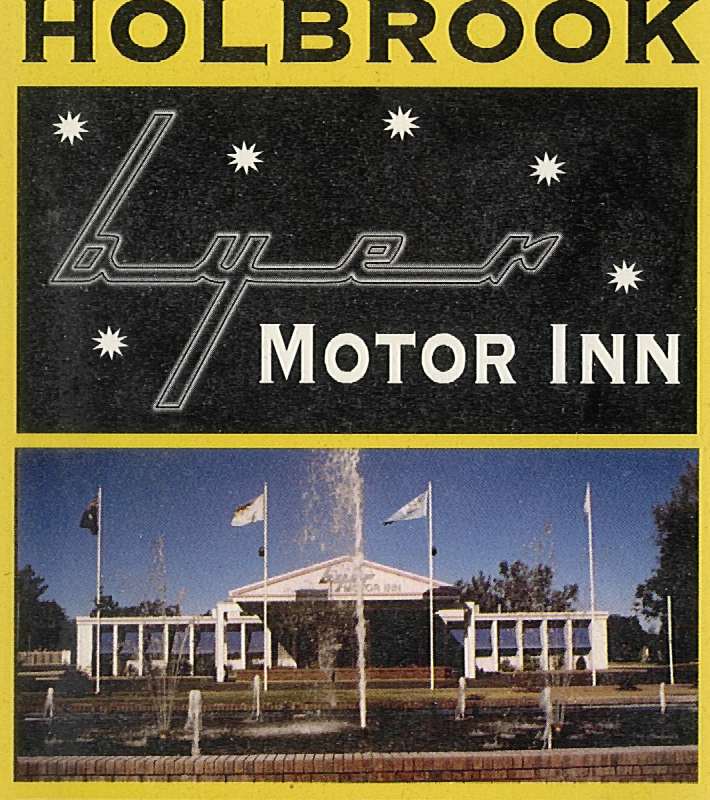
Max Byer subsequently opened a Motel in Holbrook NSW which to this
day still has the Byer logo promenantly displayed on the building.
Max passed away in January 1985.
Much of the new information was recently provided to me by Allan Rowlands who was
Max Byer's first employee, joining BRS in January 1941, Thankyou Allan for your assistance.