Byer "77" Tape Recorder
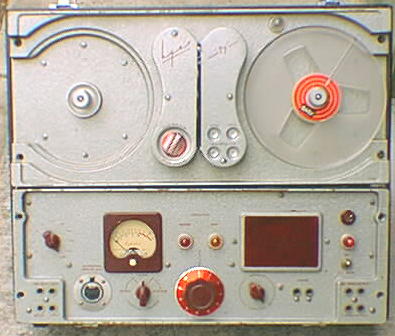
The Byer "77" was the first Australian designed and manufactured tape recorder intend for use
in professional recording applications. In Decmember 1954 this tape recorder was officially
released to the local market however, the advertising would indicate that field testing of
the unit had been underway for approximately six months. It is not clear when production of
this model ceased, the
Byer "77" Mk II was released in early 1957 but there is some
evidence that production of the Byer "77" may have continued into the early 1960's.
Reliability was the first priority in this design, the machine was solidly constructed using
cast aluminium for most of the specialised mechanical components. To ensure the long term
reliability the use of perishable rubber components was kept to an absolute minimum. The
pinch roller was the only component in the standard tape deck that used any rubber as drive
belts had been eliminated by using direct drive motors for the capstan and the spools. When
the Mk II series was released this model was then known by the broadcasting and recording
industry as the Byer "77" Mk I. The features of the unit are:
1. Direct drive capstan and spool motors (no belts).
2. Push button / solenoid operation.
3. Speed 7 1/2 and 15 ips.
4. "S" shaped tape threading path.
5. Spool locking caps.
6. The amplifier, and deck are 19" rack mountable.
7. Remote control socket, for "STOP", "START", and "REWIND" functions.
8. Adaptor arms to allow the use of 10 1/2" spools.
9. 600 ohm balanced input and output.
10. Balanced inputs for both microphone and high impedance line.
11. Mu-metal head cover for the Replay head.
12. VU meter with very good transient indication.
The Byer "77" Deck
The tape deck of the Byer "77" is very basic, there is only one rotary control which allows speeds of 7 1/2 or 15ips to be selected and
four push buttons "STOP", "START", "REWIND", "FAST FORWARD". Record or play mode is selected on the amplifier panel.
There is neon lamp on the upper right of the deck which indicates that the pinch roller is engaged. Access to the head block and pinch roller
can be obtained by removing the two covers in the centre of the deck, these covers are fastened by captive screws. The remote control socket is located on the rear of the deck along with a switch which allows the capstan motor to run continuously or only when the "START" function is used.
If the capstan motor is put in motion prior to playing or recording there is no speed up interval, only a small amount of instability in tape/head contact for a brief period when the tape motion commences.
The Byer "77" Amplifier
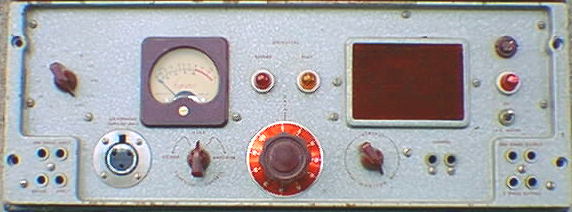
This gives you a close-up of the amplifier controls.
The amplifier panel has three types of balanced input, 50 ohm for a microphone, 600 ohm line level, and 100 kohm bridging input.
All of these inputs are connected to a single input transformer, the 600 ohm and 100 kohm connections incorporate fixed attenuators so
that similar signal levels result from each input.
To the left of the VU meter is as a switch which allows the operator to select the input to the meter. Normally the audio signal is selected
however, if there is a problem other voltages in the circuit can be monitored to isolate the possible cause of the fault.
The amplifier has three modes of operation "RECORD", "PLAY", and "AMPLIFIER". The function of the "RECORD" and "PLAY" modes is obvious, the "AMPLIFIER" mode is in fact the "RECORD" mode but the bias oscillator and record amplifier are not in circuit so no signal
can recorded.
In the centre of the panel is a 0 - 50dB stepped attenuator which is adjustable in 1dB steps. This attenuator is used to set the amplifier
gain regardless of operating mode.
To the right is the monitor speaker and associated volume control.
Unlike the later Mks of the model "77" tape recorder this one did not have tape/source switching on the line output channel eventhough the deck has separate record and reproduce heads.
The tube complement of the Byer "77" amplifier is:
1 x 5Y3GT, 1 x 12AT7, 2 x 12AU7, 1 x 12AX7, and 3 x EF86.
The Byer "77" with 10 1/2" spool adaptors
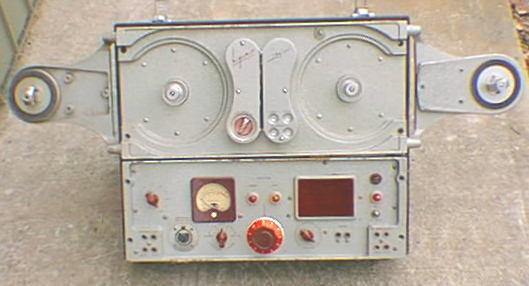
When extra playing time was required adaptor arms were fastened each side of the deck to allow the fitting of 10 1/2" spools. The hubs on the adaptor arms are grooved to locate a drive belt, there are similar sized grooves on the hubs of the spool motors to accept the belts. The spool centres are not NAB standard, they might be the same as those used on the German Magnetophone but as yet I have been unable to verify this.
If the use of adaptor arms so that large spools can be used seems familiar then it is not surprising as Magnecord Inc of Chicago used a similar arrangement with their recorders. Byer Industries probably used the idea in their machine because they had been manufacturing the Magnocorder in Australia under license.
Pre-delivery testing
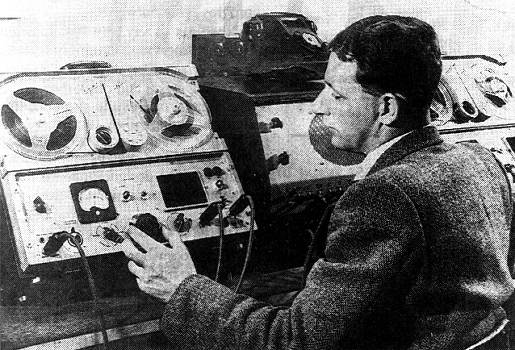
Jack Richardson (Byer factory foreman) testing Byer "77" recorders prior to delivery to the ABC for use at the 1956 Melbourne Olympic Games. (Electronics Australia, Aug 1995)
The Byer "77" shown here is currently being restored. Many vintage electronic devices have one big problem, the use of wax-paper capacitors
this tape recorder is no exception. As I hadn't powered it up for fifteen years I decided to fully check it out before so doing. Yuk...wax everywhere,
both in the amplifier sub-chassis and the deck logic control box. Also some of the wiring had deteriorated from both age and the previous owner's repair attempts. There was a better than even chance of fzzt sounds, the odd flash, and an associated brown smell if I were to switch the unit on. Well the capacitors have been replaced and so has some of the suspect wiring, at switch on there were no dramas but there are however, a couple minor faults which have to be resolved. I place more importance on electrical safety than using 100% authentic componentry. Another important issue is that of resistors, particularly carbon composition types these tend to "go high" (increase resistance) with age. In general I have found that an increase in resistance of 50 to 100% is quite common, this can change the operating points of valves and increase distortion.
If you have any comments or questions please contact me.